
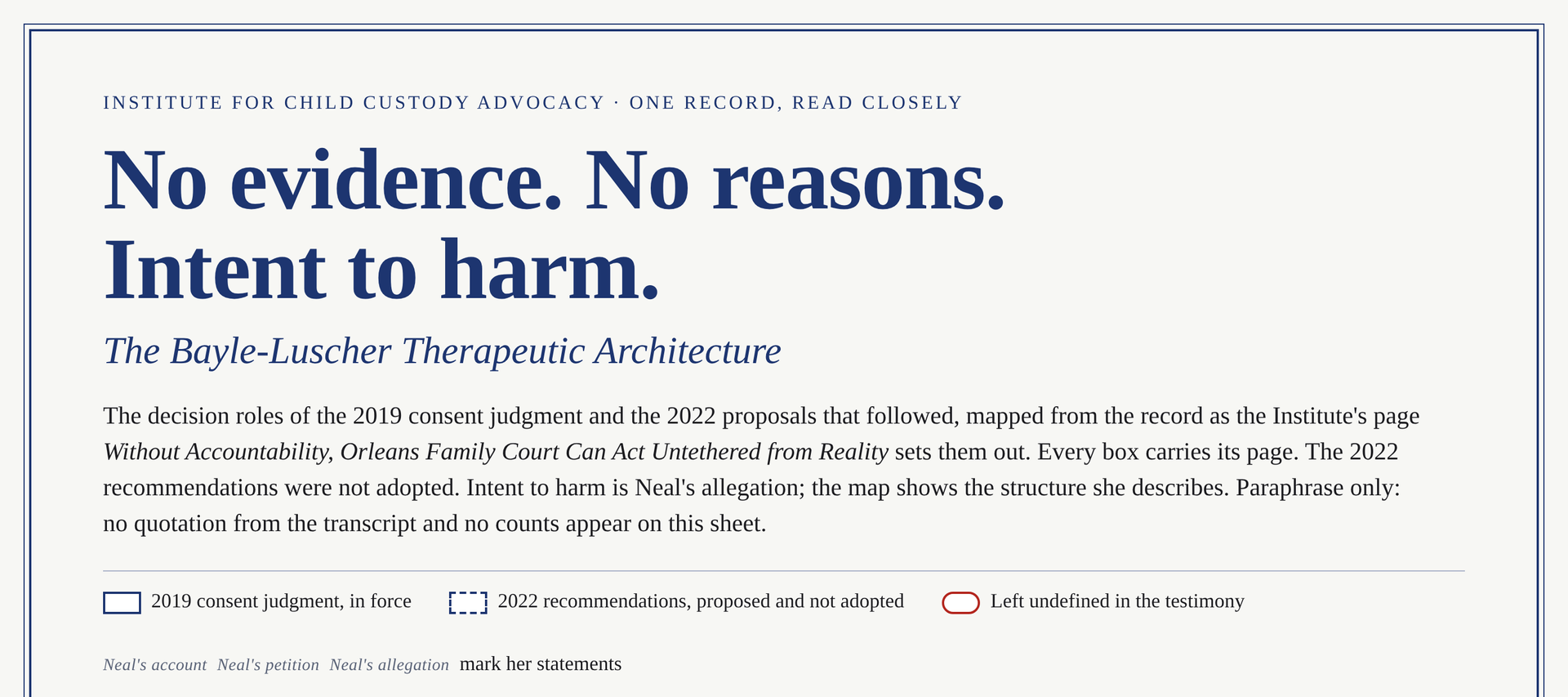
Institute for Child Custody Advocacy · One record, read closely
No evidence. No reasons. Intent to harm.
The Bayle-Luscher Therapeutic Architecture
According to Bridget Neal, this entire architecture rests on custody evaluator Kristen Luscher’s characterization of her as having a “problematic personality.” Neal states that there were no claims of drug use, alcoholism, an unsafe lifestyle, or abuse, and no medical records or mental health testimony identifying a severe mental health issue.
Neal alleges that the false narrative underlying the negative paid testimony originated with Amith Nagarajan: he manufactured it, attorney Suzanne Bayle introduced it into the proceedings, and Luscher repeated and ratified it. The map shows the resulting structure of treatment requirements, professional approvals, payments, and conditions on contact with her children.
Her allegation is that money purchased control over parental rights, with no evidence required, turning the State against a mother and allowing Family Court officers to profit from intergenerational trauma. She alleges that the Orleans judiciary protected the incompetence and the freely flowing fraud upon the court that sustained this structure, ahead of the people it was entrusted to serve.
The map
The map below shows the structure Neal describes: how the record was built, what the same people proposed in 2022, and who held each decision under the 2019 consent judgment. Every box carries its page. The 2022 recommendations were not adopted. Intent to harm is Neal’s allegation; the map shows the structure, and each line can be tested against its page.
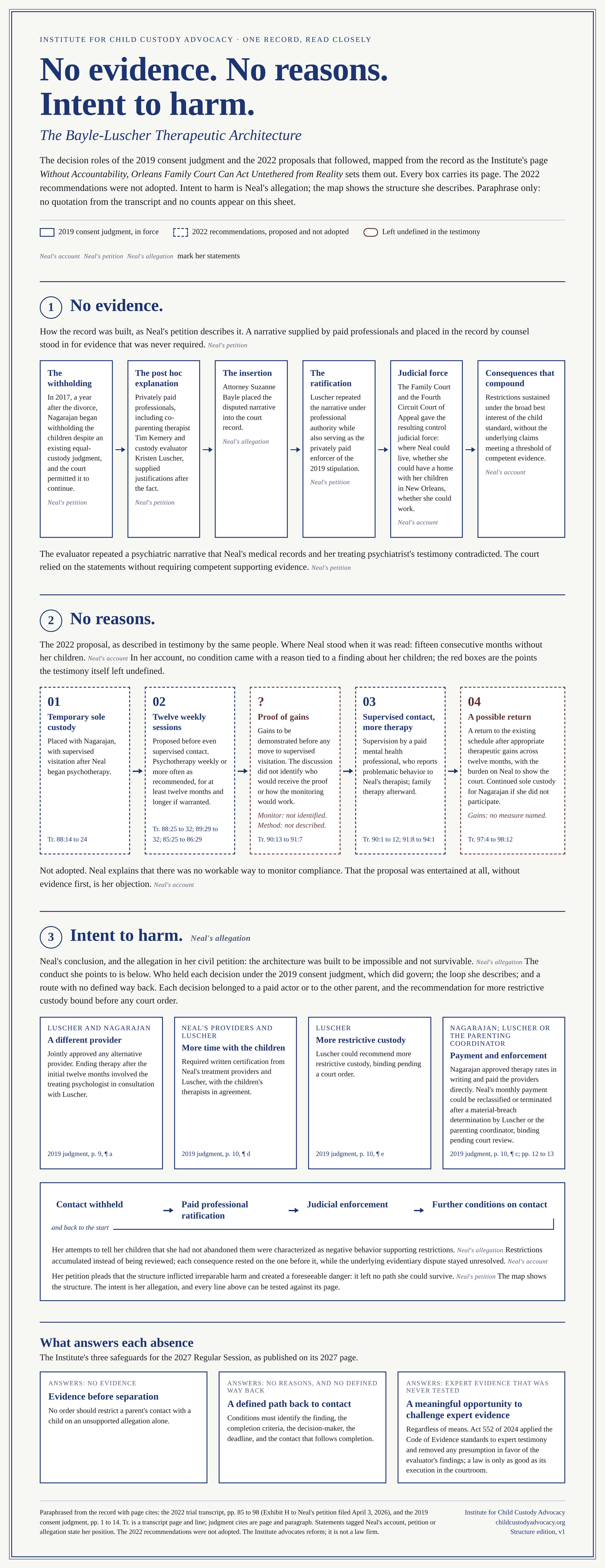

Tap a panel to open it at full size. The same content follows as text.
Neal’s conclusion, and the allegation in her civil petition, is intent to harm: the architecture was built to be impossible and not survivable. Neal’s allegation The conduct she points to: twelve weekly sessions proposed before any supervised visit, for a mother already fifteen consecutive months without her children (Tr. 88:25 to 32; 89:29 to 32); proof of gains to a person nobody at the trial could identify, by a monitoring system nobody could describe (Tr. 90:13 to 91:7); gains with no named measure, and the burden on her to show the court (Tr. 97:4 to 20); continued sole custody for Nagarajan if she did not participate (Tr. 97:21 to 98:12); and, under the judgment that did govern, more restrictive custody on Luscher’s recommendation, binding pending a court order (2019 judgment, p. 10, ¶ e), with her monthly payment subject to reclassification or termination on a material-breach determination by Luscher or the parenting coordinator, binding pending court review (pp. 12 to 13). Her petition pleads that the structure inflicted irreparable harm and created a foreseeable danger: it left no path she could survive. Neal’s petition The 2022 recommendations were not adopted; the 2019 judgment’s provisions were in force.
1 · No evidence
No evidence.
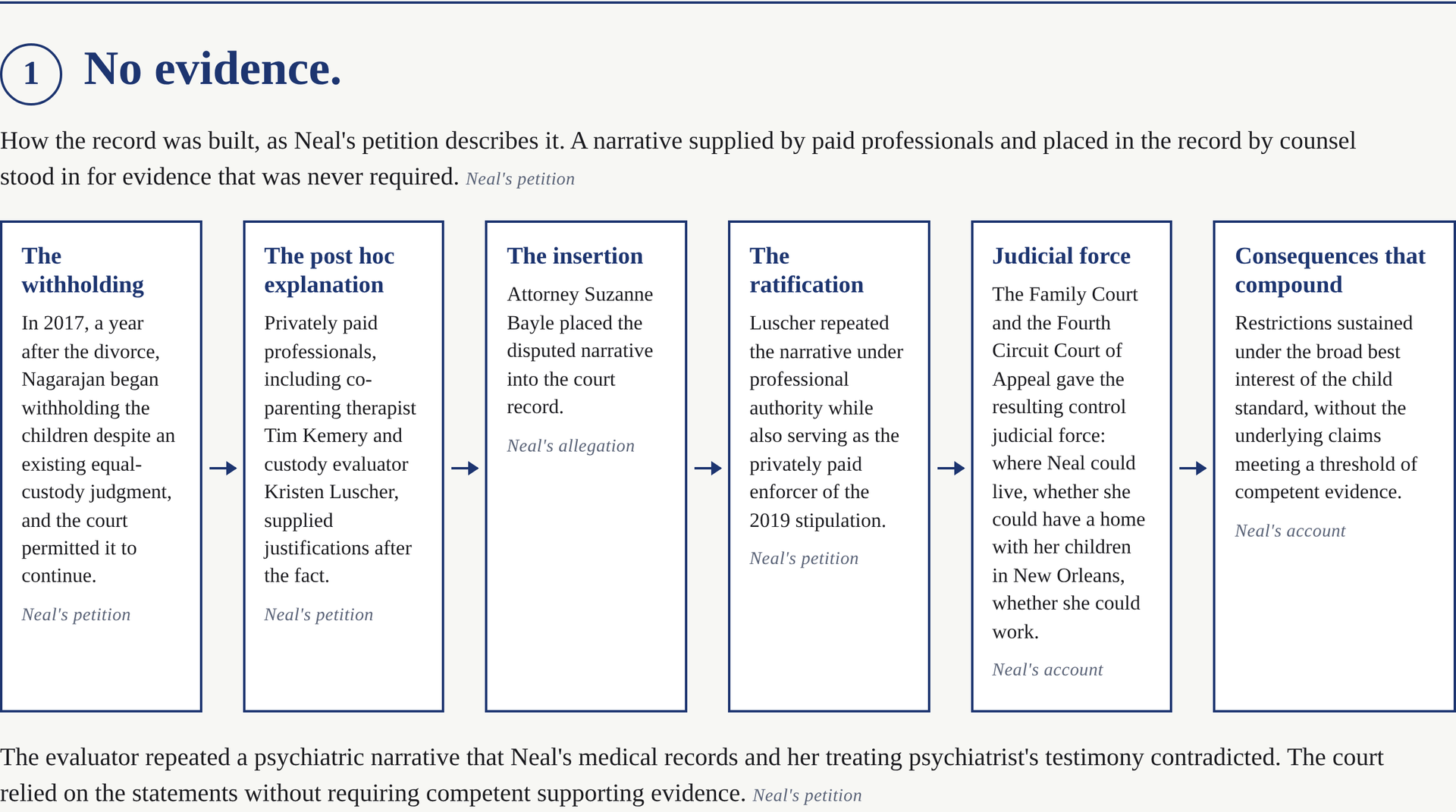
How the record was built, as Neal’s petition describes it. A narrative supplied by paid professionals and placed in the record by counsel stood in for evidence that was never required. Neal’s petition
-
The withholding
In 2017, a year after the divorce, Nagarajan began withholding the children despite an existing equal-custody judgment, and the court permitted it to continue. Neal’s petition
-
The post hoc explanation
Privately paid professionals, including co-parenting therapist Tim Kemery and custody evaluator Kristen Luscher, supplied justifications after the fact. Neal’s petition
-
The insertion
Attorney Suzanne Bayle placed the disputed narrative into the court record. Neal’s allegation
-
The ratification
Luscher repeated the narrative under professional authority while also serving as the privately paid enforcer of the 2019 stipulation. Neal’s petition
-
Judicial force
The Family Court and the Fourth Circuit Court of Appeal gave the resulting control judicial force: where Neal could live, whether she could have a home with her children in New Orleans, whether she could work. Neal’s account
-
Consequences that compound
Restrictions sustained under the broad best interest of the child standard, without the underlying claims meeting a threshold of competent evidence. Neal’s account
The evaluator repeated a psychiatric narrative that Neal’s medical records and her treating psychiatrist’s testimony contradicted. The court relied on the statements without requiring competent supporting evidence. Neal’s petition
2 · No reasons
No reasons.
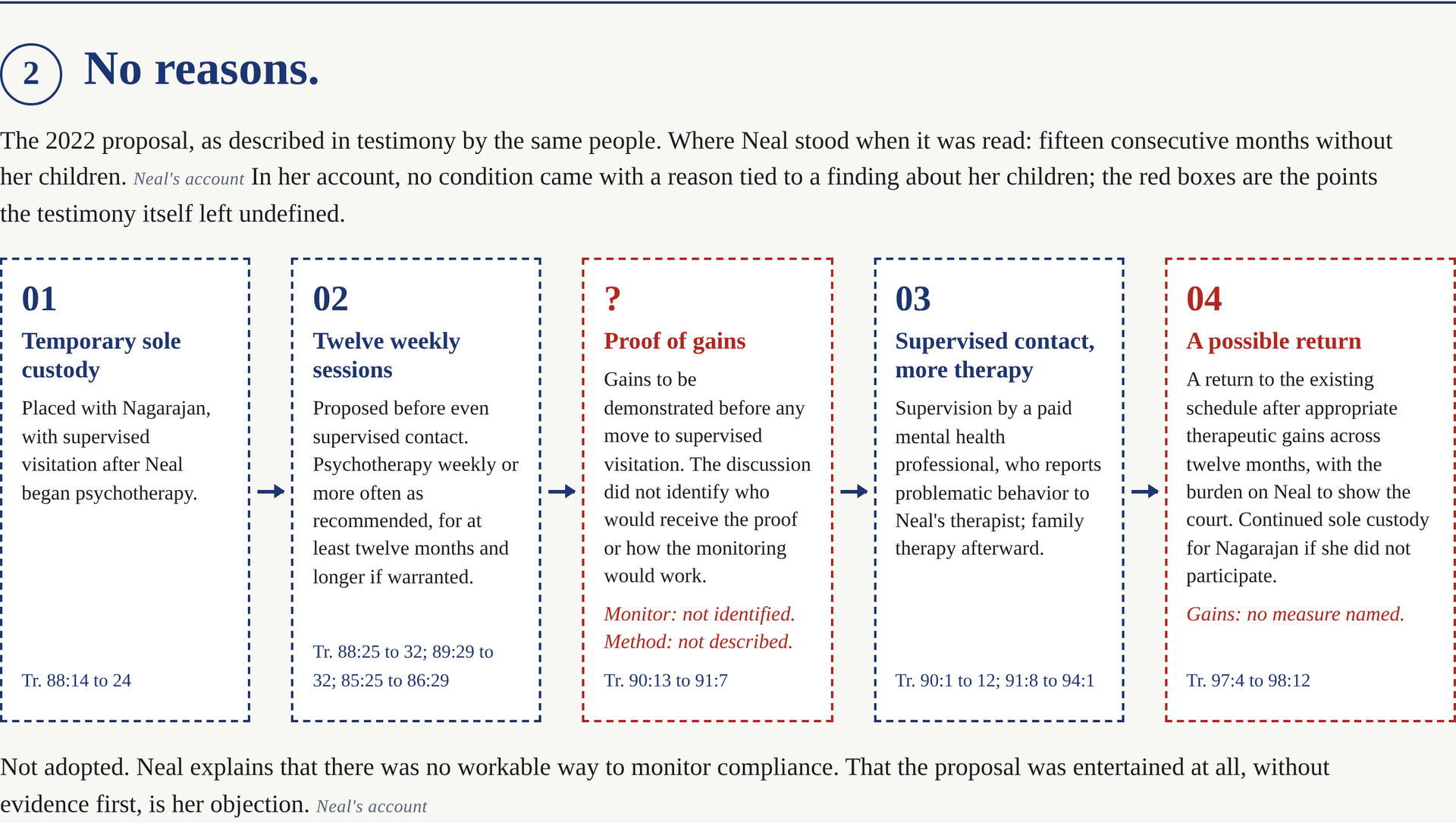
The 2022 proposal, as described in testimony by the same people. Where Neal stood when it was read: fifteen consecutive months without her children. Neal’s account In her account, no condition came with a reason tied to a finding about her children; the red boxes on the map, and the red steps below, are the points the testimony itself left undefined.
- 01
Temporary sole custody
Placed with Nagarajan, with supervised visitation after Neal began psychotherapy.
Tr. 88:14 to 24
- 02
Twelve weekly sessions
Proposed before even supervised contact. Psychotherapy weekly or more often as recommended, for at least twelve months and longer if warranted.
Tr. 88:25 to 32; 89:29 to 32; 85:25 to 86:29
- ?
Proof of gains
Gains to be demonstrated before any move to supervised visitation. The discussion did not identify who would receive the proof or how the monitoring would work.
Monitor: not identified. Method: not described.
Tr. 90:13 to 91:7
- 03
Supervised contact, more therapy
Supervision by a paid mental health professional, who reports problematic behavior to Neal’s therapist; family therapy afterward.
Tr. 90:1 to 12; 91:8 to 94:1
- 04
A possible return
A return to the existing schedule after appropriate therapeutic gains across twelve months, with the burden on Neal to show the court. Continued sole custody for Nagarajan if she did not participate.
Gains: no measure named.
Tr. 97:4 to 98:12
Not adopted. Neal explains that there was no workable way to monitor compliance. That the proposal was entertained at all, without evidence first, is her objection. Neal’s account
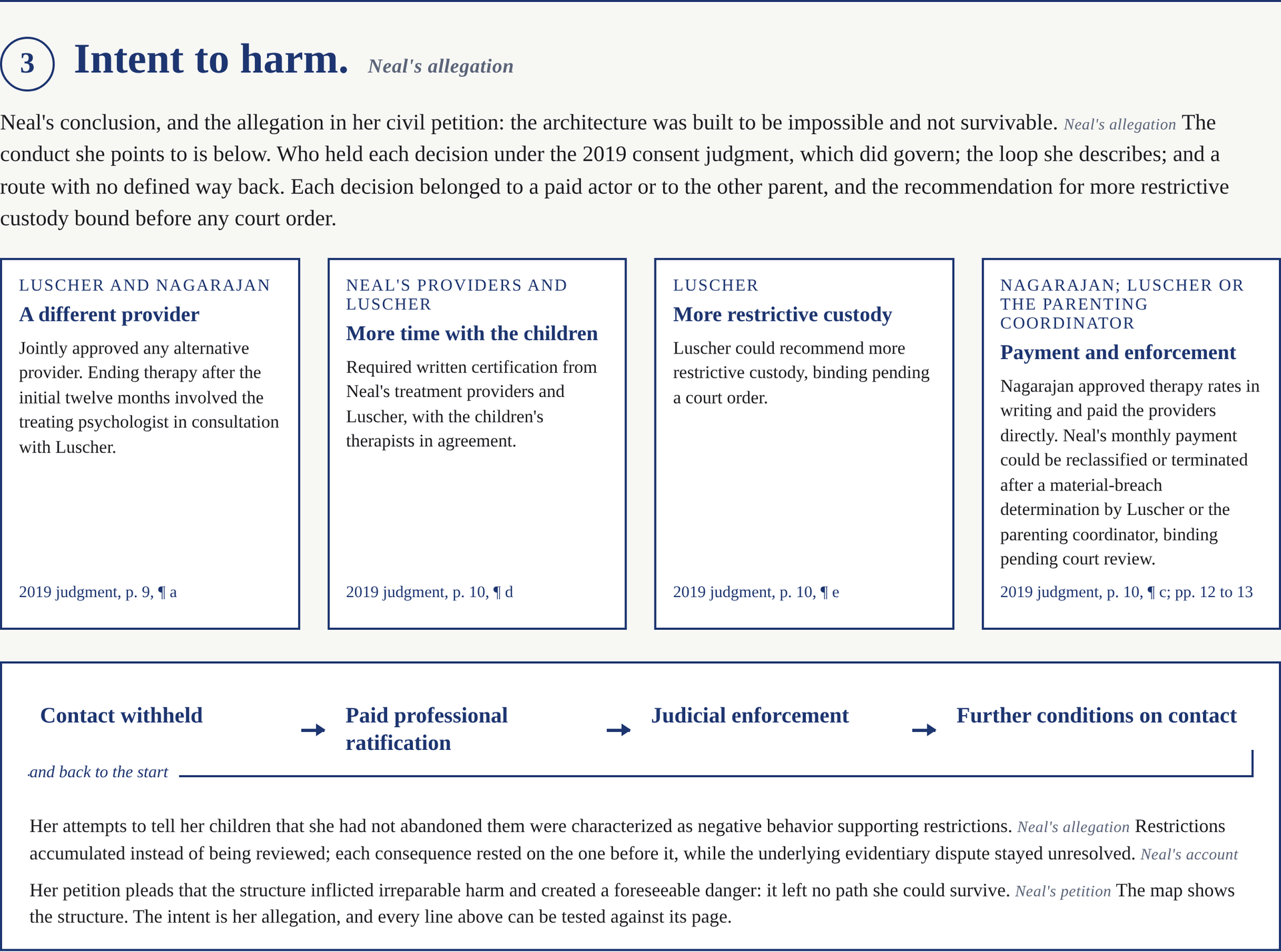
3 · Intent to harm · Neal’s allegation
Intent to harm.
Neal’s conclusion, and the allegation in her civil petition: the architecture was built to be impossible and not survivable. Neal’s allegation The conduct she points to is below. Who held each decision under the 2019 consent judgment, which did govern; the loop she describes; and a route with no defined way back. Each decision belonged to a paid actor or to the other parent, and the recommendation for more restrictive custody bound before any court order.
Luscher and Nagarajan
A different provider
Jointly approved any alternative provider. Ending therapy after the initial twelve months involved the treating psychologist in consultation with Luscher.
2019 judgment, p. 9, ¶ a
Neal’s providers and Luscher
More time with the children
Required written certification from Neal’s treatment providers and Luscher, with the children’s therapists in agreement.
2019 judgment, p. 10, ¶ d
Luscher
More restrictive custody
Luscher could recommend more restrictive custody, binding pending a court order.
2019 judgment, p. 10, ¶ e
Nagarajan; Luscher or the parenting coordinator
Payment and enforcement
Nagarajan approved therapy rates in writing and paid the providers directly. Neal’s monthly payment could be reclassified or terminated after a material-breach determination by Luscher or the parenting coordinator, binding pending court review.
2019 judgment, p. 10, ¶ c; pp. 12 to 13
...and back to the start. How Neal says the restrictions operated. The 2022 recommendations were proposals, not an adopted order; the 2019 consent judgment did govern. Neal’s allegation
Her attempts to tell her children that she had not abandoned them were characterized as negative behavior supporting restrictions. Neal’s allegation Restrictions accumulated instead of being reviewed; each consequence rested on the one before it, while the underlying evidentiary dispute stayed unresolved. Neal’s account
Her petition pleads that the structure inflicted irreparable harm and created a foreseeable danger: it left no path she could survive. Neal’s petition The map shows the structure. The intent is her allegation, and every line above can be tested against its page.
Evidence before consequence
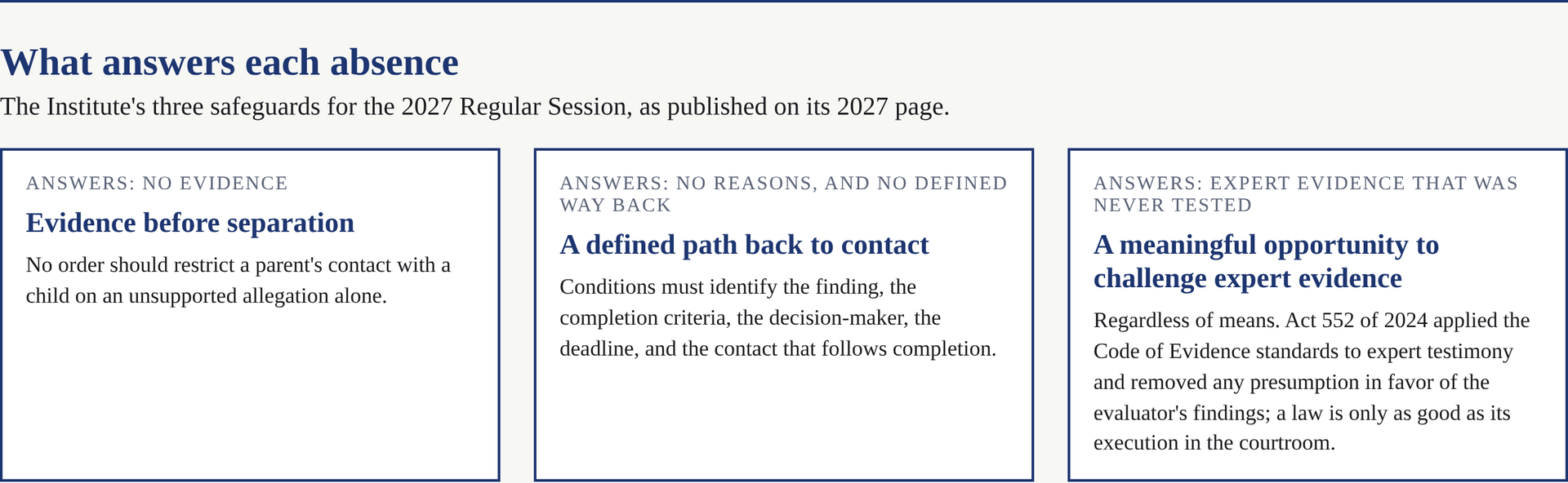
What answers each absence
The Institute’s three safeguards for the 2027 Regular Session, as published on its 2027 page.
Answers: no evidence
Evidence before separation
No order should restrict a parent’s contact with a child on an unsupported allegation alone.
Answers: no reasons, and no defined way back
A defined path back to contact
Conditions must identify the finding, the completion criteria, the decision-maker, the deadline, and the contact that follows completion.
Answers: expert evidence that was never tested
A meaningful opportunity to challenge expert evidence
Regardless of means. Act 552 of 2024 applied the Code of Evidence standards to expert testimony and removed any presumption in favor of the evaluator’s findings; a law is only as good as its execution in the courtroom.